Walk into almost any Montana bank and ask about a home loan, and somewhere in the conversation you'll hear a version of the same line: "We keep your mortgage right here. We don't sell your loan like the big guys do."
Here's the thing about that pitch: if you're getting a standard 30-year fixed-rate mortgage, the bank is almost certainly selling your loan. Not sometimes — as a matter of routine. That isn't a guess about what happens behind the counter. Every bank reports exactly what it keeps and what it sells to federal regulators, every quarter, in public filings. We pulled those filings for every Montana bank. The numbers are below.
Why No Bank Wants to Keep a 30-Year Fixed Loan
Think about what a bank would be signing up for if it actually kept your 30-year fixed-rate loan. The bank's money comes from deposits — checking accounts, savings accounts, CDs — and the interest it pays on those changes all the time. Your mortgage rate is locked until the 2050s.
Now imagine rates rise. The bank is paying more for deposits every month, while your loan pays it the same fixed rate for decades. That mismatch — money locked up for 30 years, funded by money that can leave next week — is exactly what wiped out the savings-and-loan industry in the 1980s, and every bank examiner in America has been trained on that lesson since. A bank keeping a big pile of 30-year fixed mortgages isn't being neighborly. It's taking a risk regulators specifically warn against.
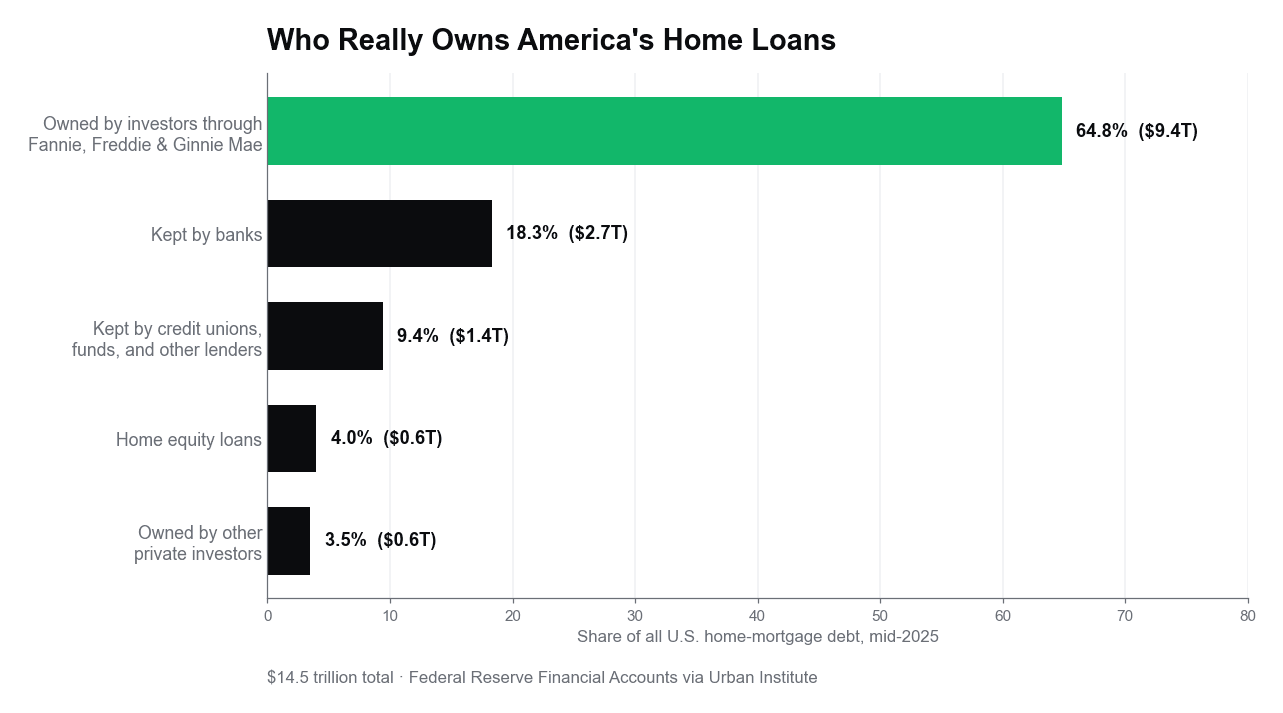
So banks don't keep them. Instead, they sell those loans — mostly to Fannie Mae and Freddie Mac, two giant government-backed companies whose entire job is buying home loans from banks. Fannie and Freddie bundle the loans into bonds and sell those to investors who are built to wait 30 years: pension funds, insurance companies, even the Federal Reserve. That system is the reason a 30-year fixed-rate mortgage can exist at all. Roughly two-thirds of all the home-loan debt in America is owned this way. The share banks keep for themselves is small:
The Montana Numbers
You don't have to take the national picture on faith. Every bank files a detailed quarterly report with federal regulators listing what it holds, category by category — including how much of its lending is locked in long-term. We pulled the December 31, 2025 reports for every Montana-based bank. Here's what their lending actually looks like:
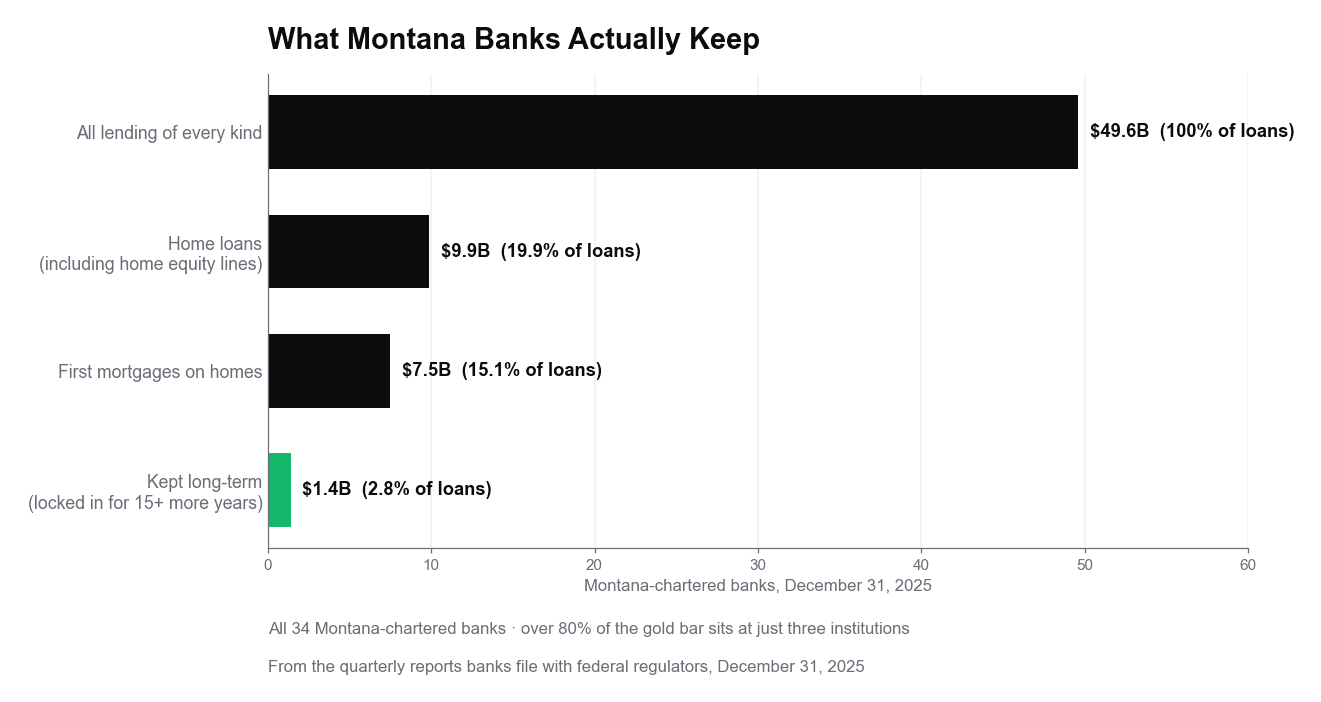
Montana's banks have $49.6 billion in loans of every kind. Just 19.9% of that — $9.9 billion — is home loans at all, and that includes home equity lines and second mortgages. The other four out of five dollars is business, farm, and commercial real estate lending. Home loans aren't the business Montana banks are in; they're a side counter in the business they're in.
Now the number that settles the myth. Banks also have to report how much of their lending is locked in for more than 15 more years — the only place a kept 30-year fixed mortgage can show up. Across all 34 Montana banks combined, that bucket totals $1.4 billion — 2.8% of their lending. And even that small number overstates it: more than 80% sits at just three institutions, including a couple whose deliberate, old-fashioned business model is keeping every loan they make. Set those aside, and Montana's other 31 banks hold about $240 million of long-term home loans against $22.7 billion of lending — about a penny on the dollar.
And of the home loans Montana banks do keep, roughly four out of five dollars will hit a rate change or payoff within 15 years — adjustable-style loans whose rates move with the bank's own costs. For the typical Montana bank, the kept 30-year fixed mortgage isn't a product. It's a rounding error.
The mortgage sellers show it in their own filings
There's one more report. Banks that do a meaningful amount of mortgage lending must file an extra schedule showing, dollar for dollar, how many home loans they made in order to sell — and how many they sold. Exactly four Montana banks did enough mortgage business in 2025 to file it. Combined, those four:
- Sold $1.45 billion of home loans during 2025 — essentially everything they produced for sale; and
- Were collecting payments on $5.3 billion of home loans owned by someone else at year-end.
Put those numbers side by side. In a single year, Montana's mortgage-active banks sold $1.45 billion of home loans — more than the entire industry has accumulated in kept long-term home loans in its history — and they collect payments on well over three times that amount for other owners. Even some smaller banks that don't meet the filing threshold carry "mortgage servicing rights" on their books — an asset that only exists when you're collecting payments on loans you sold.
What "We Keep Your Mortgage" Actually Means
So what is the bank keeping? Usually one thing: the payment-collection job, which the industry calls servicing. When the bank sells your loan, it can also keep the right to collect your monthly payment, manage your escrow account, and send your statements. Many Montana banks do — and that's the kernel of truth in the pitch. Your payment really does go to the bank downtown, the statement really does carry their logo, and a local person may really answer the phone.
But follow your check. The bank keeps a small fee for collecting it — typically about a quarter of one percent per year. The rest — your principal and nearly all of your interest — is passed along to the investors who own your loan. The accurate version of the pitch would be: "We sold your mortgage, probably to Fannie Mae, but we kept the paperwork."
That's a real service. It is not ownership. And even the payment-collection job gets bought and sold — the bank "keeping" your mortgage today can sell that job to a company you've never heard of next year, and you don't get a vote.
"But My Banker Said They Keep Their Loans"
When they say they "keep" it, here's what that means in practice: they're paid to collect your payment and forward it to whoever owns the loan. And in the meantime, the bank holds your money — your payment sits with them until it's passed along, and your escrow for taxes and insurance sits with them for months — earning the bank interest the whole time. Collecting isn't a favor to you. It's a paid job, plus free use of your cash.
Now, banks do genuinely keep some loans — just not the one we're talking about. The products that stay at a bank: adjustable-rate loans whose rates reset along with the bank's own costs, very large loans above Fannie and Freddie's limits, construction loans, home equity lines, and loans on unusual properties. Those are designed to sit at a bank.
That's the sleight of hand in the pitch: "we keep our loans" is true of one set of products and quietly applied to another. The loan the bank keeps is an adjustable that resets in five years or a construction loan that pays off in twelve months. The loan you're asking about — the standard 30-year fixed — is sold. If a banker tells you otherwise, ask one clarifying question: "A 30-year fixed, and you'll still own it in year ten?" Watch the answer get complicated.
Why This Matters to You
The rules were never the bank's rules
Because your loan is headed to Fannie Mae or Freddie Mac, it was approved using their rulebook from the start — the income requirements, the paperwork, the appraisal standards. A bank writing a standard loan and a broker writing a standard loan are building the exact same product, by the exact same rules, headed to the exact same place. The "relationship" doesn't change a line of it.
The sale can't change your loan
The flip side, and it's genuinely good news: it doesn't matter who owns your loan, because nobody can change the terms. Your rate, your payment, and your payoff schedule are set by the papers you signed. Federal law requires the new owner to notify you when your loan is sold, requires notice before your payment-collection job moves, and gives you a 60-day grace period where a payment sent to the old company can't be counted late. The sale of your loan is an event on Wall Street, not in your life.
So what should you shop for?
If the loan ends up in the same place either way, the only things worth comparing are the rate, the costs, and whether the program actually fits your finances. Paying extra for the feeling that the bank "keeps" a loan it sold in March is paying for a story.
Don't Take Our Word for It — Look Yours Up
If you already have a mortgage from a bank that told you they keep their loans, it takes about two minutes to check:
- Fannie Mae loan lookup: yourhome.fanniemae.com
- Freddie Mac loan lookup: myhome.freddiemac.com
- Or ask the company you pay. Under federal law, they must tell you, on request, the name, address, and phone number of whoever owns your loan. The CFPB publishes a guide and sample letter.
You may find the myth sitting in a Fannie Mae pool.
Where a Broker Fits
We're a mortgage broker. We don't own the loans we arrange either — and we've never claimed to. The difference is that we don't charge you extra for a story. A standard loan through us ends up in the same Fannie or Freddie hands it would from any bank, approved by the same rules — so the only question is who gets you the better rate and lower costs on the way in. We shop that across many lenders. And for the borrowers the standard rulebook treats worst — the self-employed, 1099 earners, investors — we can shop specialty programs across many lenders instead of the one loan menu in the building.
Ask any lender you're talking to — including us — two questions: "Will you own my loan a year from now?" and "Will you be the one collecting my payment?" The honest answers tell you what you're actually buying.
Curious where your loan would land, or what your options look like? Get pre-approved or call us at (406) 760-1985 — we'll give you the version without the myth.
Sources: quarterly financial reports (FFIEC call reports) filed by every Montana-chartered bank — loan holdings and long-term lending detail as of December 31, 2025, and mortgage sale activity summed across all four quarters of 2025; Federal Reserve data on who owns U.S. mortgage debt, as compiled by the Urban Institute (December 2025); Consumer Financial Protection Bureau consumer guidance on mortgage ownership. Figures are market totals; individual loans and banks vary.