This is the first in an occasional series taking one Montana market and running it through key datasets we follow. We start with Butte — because four independent sets of public data are all pointing the same direction, and it isn’t up. Mortgage lending, building permits, seller price cuts, home-equity borrowing, and asking prices each tell a piece of the same story: the least expensive major market in Montana is getting weaker, and price isn’t the reason.
The headline numbers, before we walk through them:
| Signal | Reading |
|---|---|
| Core mortgages ($300K–$500K), May year over year | −27% |
| Building permits, April–May year over year | −36% |
| Active listings with at least one price cut | 42% |
| Median asking price per square foot | $197 — lowest major market |
Why Butte matters: it’s the floor
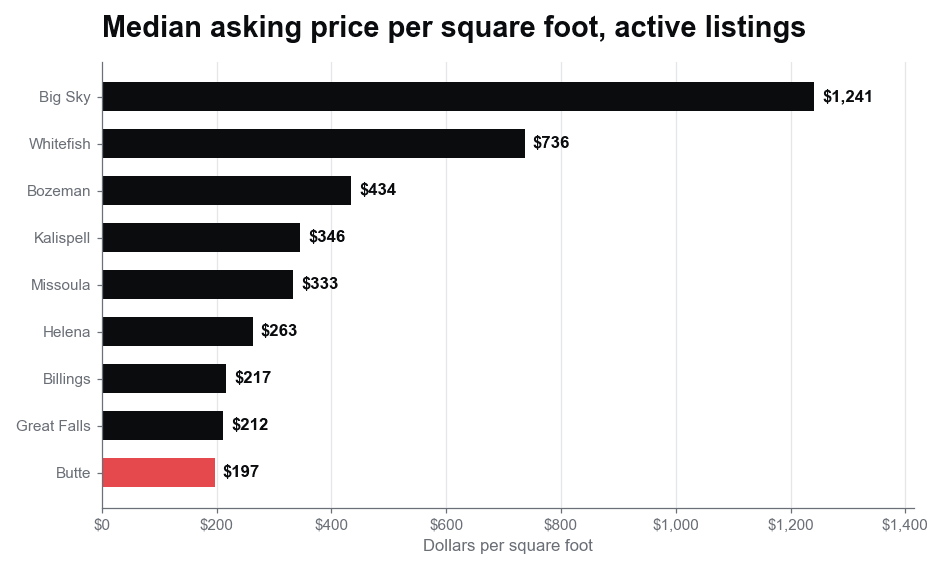
Butte is the least expensive major housing market in Montana, and it isn’t close. The median active listing asks $197 per square foot — below Great Falls at $212, below Billings at $217, and less than half of Bozeman’s $434. The median asking price across Butte’s 193 active residential listings is about $305,000, against a statewide median of $599,000.
That position is exactly what makes Butte worth watching. In most soft Montana markets, the explanation is price — homes have simply outrun what local incomes can finance. Butte doesn’t have that excuse. When demand fades in the one major market where affordability is not the obstacle, whatever is happening is about demand itself. That is a different, and more telling, kind of weakness.
Signal one: fewer buyers are financing homes
In our statewide mortgage report earlier this month, one number stood out: Butte posted the steepest lending decline of any major Montana market. Core residential mortgages — loans in the $300K–$500K band, the heart of the market — fell 27% year over year in May, from 22 to 16. Missoula grew 27% over the same period; the Flathead grew 15%; Billings held flat.
Butte is a small market, and a single month of loan counts is a noisy measure on its own. That is precisely why this report exists: one soft data point is an anomaly. Four soft data points, from four unrelated sources, are a trend.
Signal two: the spring building season didn’t show up
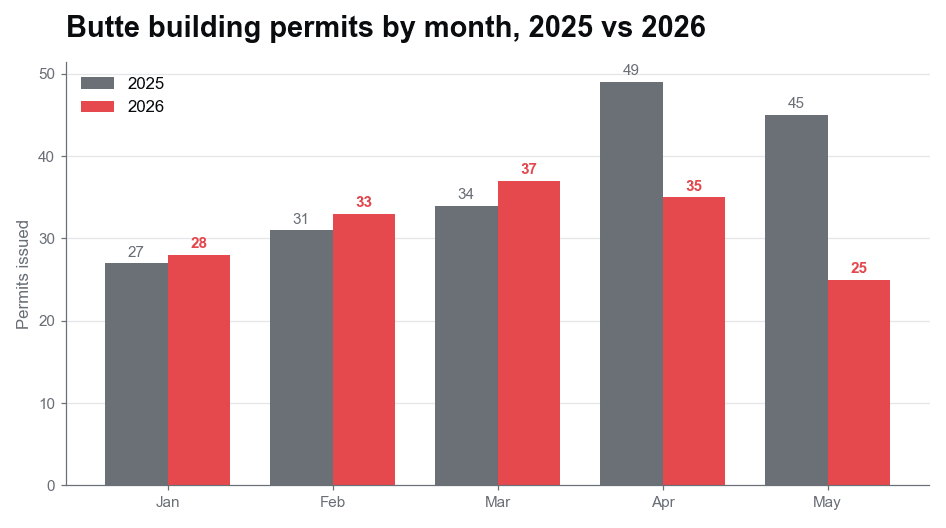
Building permits are where local confidence shows up in writing — every remodel, addition, and new build starts with one. Through the winter, Butte was fine: January through March 2026 actually ran slightly ahead of the same months last year, 98 permits against 92. Then spring arrived and the season didn’t. April and May produced 60 permits against 94 in the same two months of 2025 — a 36% drop in what should be the busiest stretch of the building calendar.
For the year through May, Butte permits are down 15%. But the shape of the decline matters more than the total: this is not a market that has been slowly cooling for a year. It held its footing through winter and then stepped back exactly when property owners normally step forward.
Signal three: sellers are cutting deeper than the rest of the state
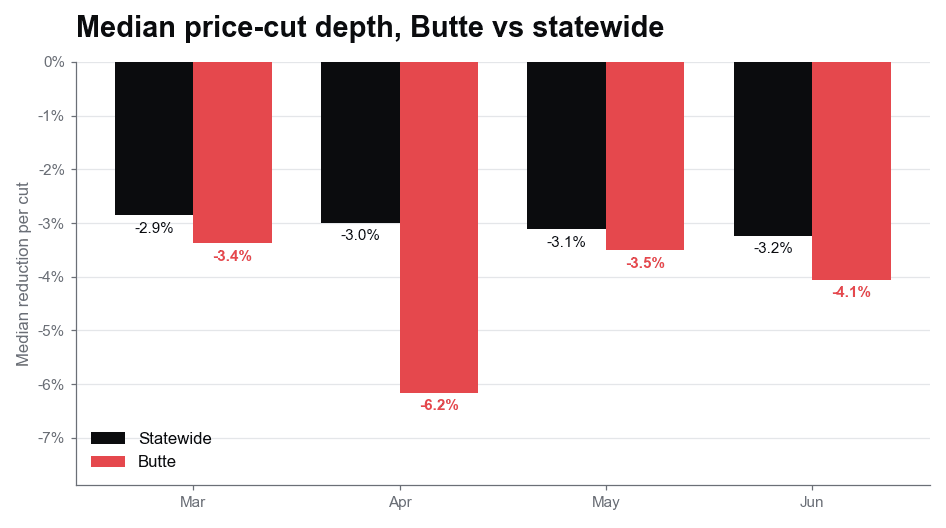
Of Butte’s 193 active residential listings, 82 — about 42% — have reduced their asking price at least once, slightly above the statewide share of 40%. The more revealing number is how deep those cuts go. The median Butte price reduction this spring ran −3.7%, against −3.4% statewide — and Butte sellers have cut deeper than the state in every single month from March through June. In April, the median Butte cut hit −6.2%, roughly double the statewide figure that month.
Remember the base these cuts come off. A 4% reduction on an $880,000 Bozeman listing is a negotiation. A 4% reduction on a $305,000 Butte listing — in the cheapest major market in the state — is a seller telling you what the buyer traffic looks like.
Signal four: the equity tap is quiet too
Late last month we mapped Montana’s junior liens — the home-equity lines and second mortgages homeowners stack on top of a first loan. Butte’s county sits at the bottom of that map: about 1 in 14 homes carries a junior lien, the lowest penetration of any major Montana county. In Helena’s county it is roughly 1 in 8; Missoula, about 1 in 10.
This one is structural, not a 2026 development — but it completes the credit picture. Across the rest of Montana, locked-in homeowners have been converting record home equity into spendable cash through second loans, and that borrowing feeds directly into local renovation, small-business, and consumer spending. Butte largely sits that boom out: home values are the lowest in the state, so there is less equity in dollar terms to tap, and lenders write fewer of these loans there. Put it alongside the purchase-mortgage decline and the picture is consistent — housing credit, in both directions, flows more thinly through Butte than anywhere comparable. When demand softens, there is less cushion underneath.
Off the spreadsheet: what’s happening on the ground
The data doesn’t exist in a vacuum, and Butte’s local news over the past eighteen months reads like a companion piece. REC Silicon — one of Butte’s flagship industrial employers, operating south of town since 1996 with roughly 235 workers at its recent peak — shut down its polysilicon production at the end of 2024, cut about 10% of its remaining workforce this past December, and has spent 2026 reporting losses and working through a restructuring that took the company private in June.
Then came April. Butte’s biggest prospective development — a Sabey data center planned for 600 acres at the Montana Connections industrial park, pitched with hundreds of permanent jobs and 600 construction jobs attached — fell through when REC Silicon exercised a right of first refusal on the land on April 17. Sabey has since backed away from the Butte site. Look back at the permit chart above: April is exactly the month Butte’s building activity fell out of bed. We can’t prove one caused the other, but a town’s property owners don’t pull permits for a future they’ve stopped believing in.
Healthcare, one of Butte’s largest employment anchors, is under its own strain: unions report the local hospital’s surgical staff has fallen from about ten surgeons to four amid a provider exodus, and its parent system announced statewide job cuts this summer. The counterweight is real, though — copper prices are strong, the mine is running high-grade ore, and mining employment looks solid. Butte isn’t losing its base. What it lost this spring was its momentum story — and the housing data caught it within weeks.
What the data does not show
Butte is not drowning in stale inventory. The median active listing has been on the market 68 days, against 90 statewide, and 37% of Butte listings have sat three months or longer versus roughly half of listings statewide. This is not a glut — homes that are priced to the market still move, and faster than they do in Bozeman or the Flathead. Nor is 193 active listings an unusual load for a market Butte’s size.
That distinction matters for reading what comes next. A market with too much supply heals when the supply clears. A market with thinning demand — fewer mortgages written, fewer permits pulled, sellers reaching further to find a buyer — heals only when the demand comes back. Butte’s problem, on today’s evidence, is the second kind.
Four datasets, one direction. Lending down 27%. Spring permits down 36%. Price cuts deeper than the state every month since March — in the one major market where price was never the problem. That’s a demand signal, not a price signal.
What this means
For buyers, Butte is now one of the strongest negotiating positions in Montana. Fewer competing buyers are getting financed, sellers are already cutting, and the cuts are running deeper than anywhere comparable. On a home that has taken one price reduction and sat past 60 days, there is room — the data says the seller knows it.
For sellers, the lesson is in the days-on-market number. Butte homes that are priced to the market still sell — and sell faster than the statewide pace. The listings taking 6% cuts are the ones that started high and chased the market down. In a thin-demand market, the first price is the one that matters.
For investors, Butte’s math cuts both ways. At $197 per square foot, entry basis is the lowest of any major Montana market, and rental yield on cost is correspondingly the highest — softness like this is when basis gets acquired. But the same data is a warning about exit liquidity: fewer financed buyers means fewer people to sell to. Butte right now favors the investor who buys for cash flow and patience, not the one counting on appreciation or a quick resale.
We’ll keep running Butte through each month’s data. If the summer permit numbers recover and the mortgage count stabilizes, this spring reads as a stumble. If they don’t, Butte will have told us first — in writing, across four public datasets.
If Butte’s buyer’s market has you looking — or you’re selling and want to price it right the first time — get pre-approved or give us a call at (406) 760-1985. We’ll run the numbers for your specific situation and give you an honest read on the market you’re walking into.
Market Spotlight is a market intelligence series published by Renegade Financial. All figures are aggregate counts derived from aggregate public recorded-document data, public permit records, and aggregate active-listing market data. No individual borrower, property address, or account number is identified. Data is presented without warranty and does not constitute financial or legal advice.